Ask a raw LLM to judge how well a candidate fits a role, and it will happily make something up — it has no idea what your job actually requires, or what's really in the resume in front of it. Retrieval-Augmented Generation, or RAG, is the fix: instead of relying purely on what the model memorized during training, you retrieve the actual, current, relevant facts and hand them to the model as part of the prompt.
How RAG works, concretely
- Content — a job description, a resume, a knowledge-base article — is broken into chunks and converted into vector embeddings, numerical representations that capture meaning, not just keywords.
- Those embeddings are stored in a vector database, alongside the source text.
- When a question comes in, the system embeds the question the same way and retrieves the chunks whose meaning is closest — even if they don't share exact wording.
- The retrieved chunks are inserted into the model's prompt as grounding context, and only then does the LLM generate its answer.
The result is an answer that's actually anchored in your real data instead of the model's fuzzy memory of the internet. It's also auditable: because you know exactly which chunks were retrieved, you can trace why the model said what it said.
Where we lean on RAG
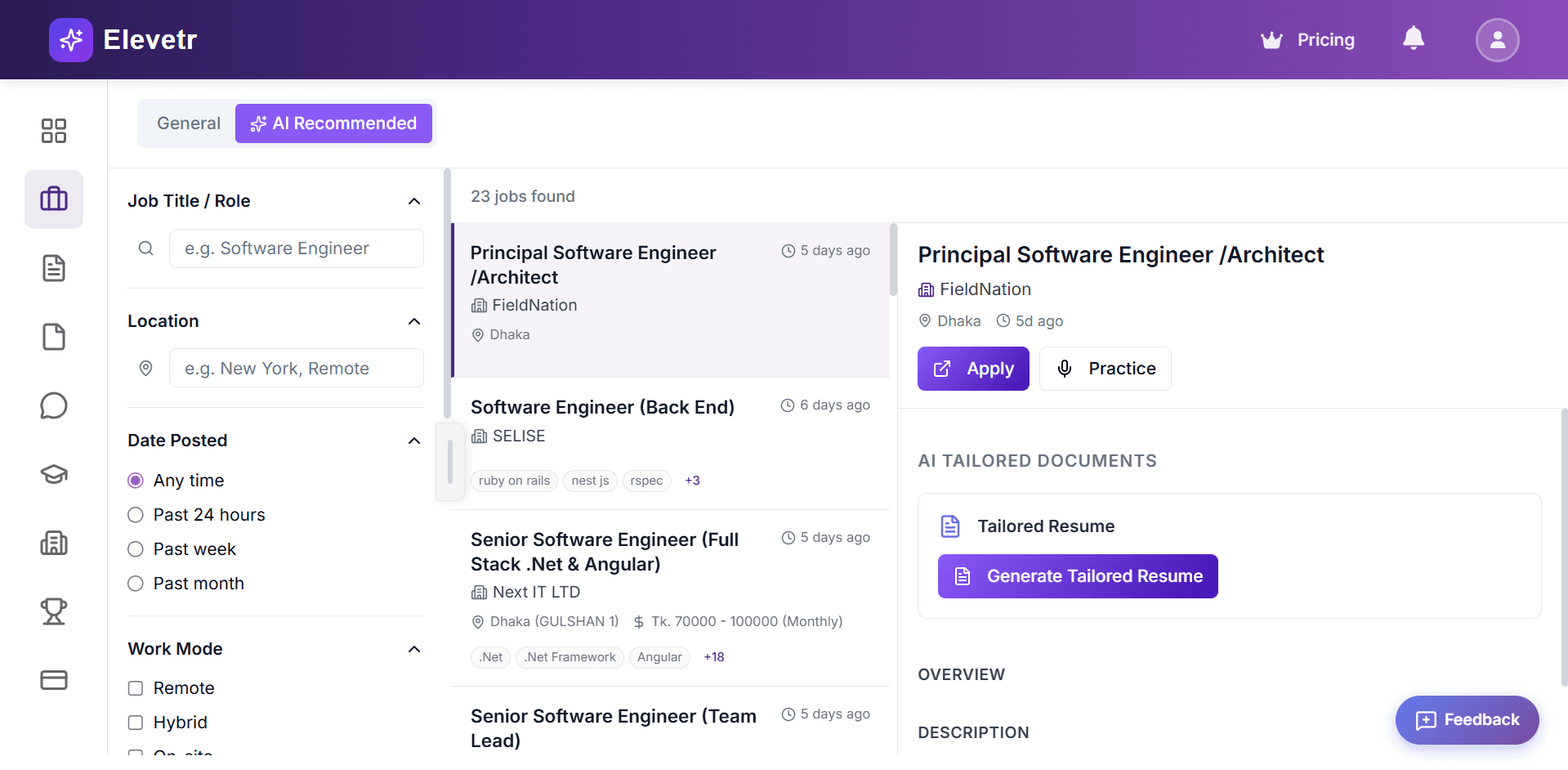
Every resume-to-job match on Elevetr Jobs works this way: the full job description and the full resume are retrieved and read together, and the model is asked to judge genuine requirement fulfillment — not vocabulary overlap. That distinction matters more than it sounds; a naive keyword or embedding-similarity match will happily score a marketing resume highly against a software engineering role just because both mention the same company name. Reading the real content, requirement by requirement, is what makes the score trustworthy.
RAG isn't a silver bullet
Retrieval quality is everything — if you chunk content badly or retrieve the wrong passages, the model will confidently reason from the wrong facts. That's why the unglamorous engineering work — chunking strategy, embedding model choice, re-ranking — usually matters more to real-world accuracy than which flagship LLM sits on top. It's also why we treat every AI feature as a full pipeline, not a single API call.